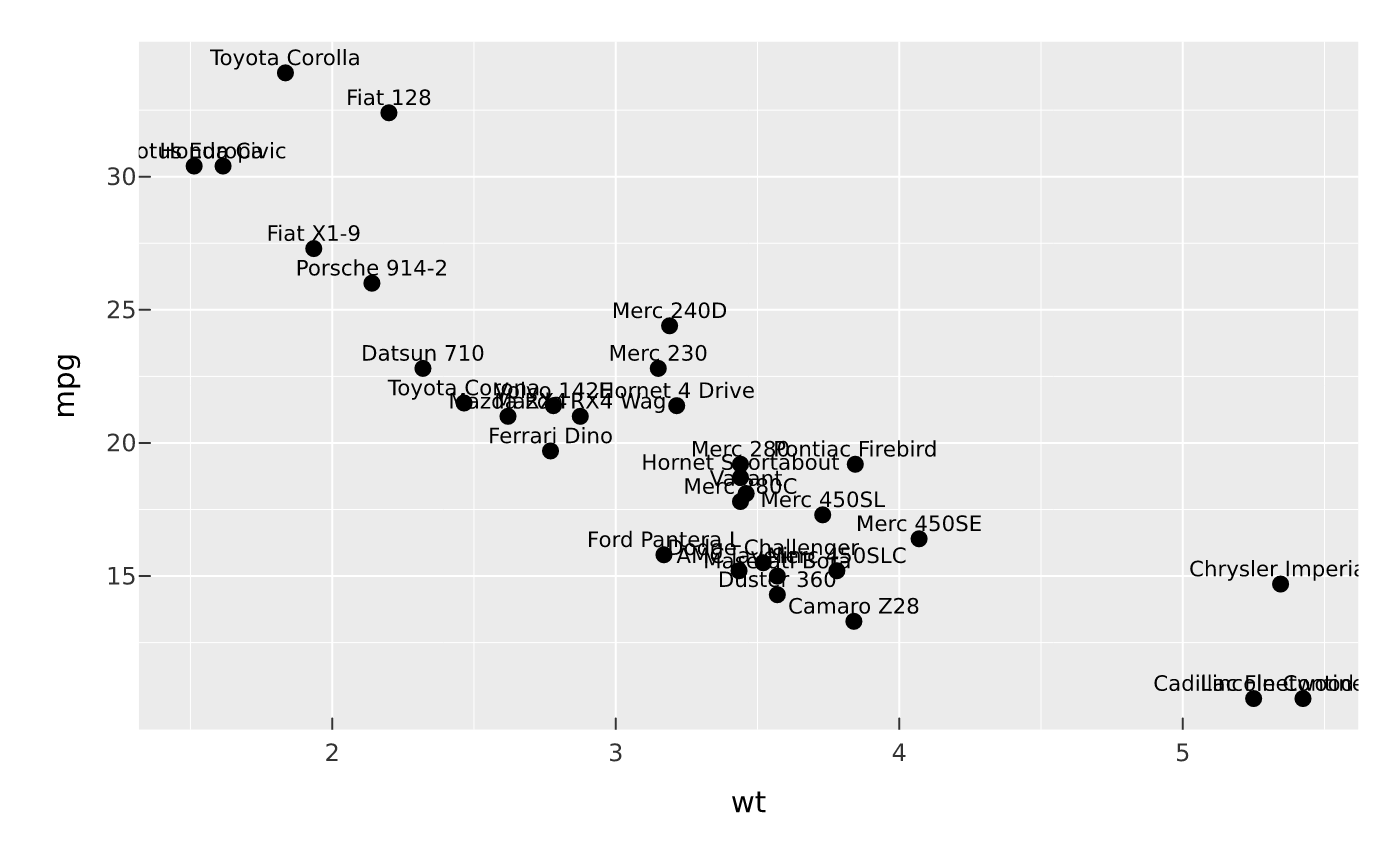
mark_text() draws the label aesthetic as text at each (x, y);
mark_label() adds a filled rounded background behind each label. size is
the font size in points; angle (degrees) may be mapped or constant.
Usage
mark_text(
  plot,
  ...,
  size = NULL,
  family = NULL,
  fontface = NULL,
  hjust = "centre",
  vjust = "centre",
  angle = NULL,
  nudge_x = 0,
  nudge_y = 0,
  repel = FALSE,
  box_padding = 1,
  point_padding = 1,
  min_segment_length = 2,
  seed = NULL,
  effects = list(),
  blend = NULL,
  data = NULL
)

mark_label(
  plot,
  ...,
  size = NULL,
  family = NULL,
  fontface = NULL,
  hjust = "centre",
  vjust = "centre",
  angle = NULL,
  nudge_x = 0,
  nudge_y = 0,
  fill = "white",
  repel = FALSE,
  box_padding = 1,
  point_padding = 1,
  min_segment_length = 2,
  seed = NULL,
  effects = list(),
  blend = NULL,
  sketch = NULL,
  data = NULL
)
Arguments
- plot
- ...
Encodings (tidy-eval):
x,y,label(+color,angle).- size
Font size in points.
- family, fontface
Font family / face (
"plain","bold","italic","bold.italic").- hjust, vjust
Horizontal / vertical justification (constant;
"left","centre","right","bottom","top", or numeric in[0, 1]).- angle
Text rotation in degrees.
- nudge_x, nudge_y
Shift each label by an exact absolute distance in millimetres (
+xright,+yup), device-resolved so the nudge is constant regardless of scale or panel aspect. Default0.- repel
Move overlapping labels apart (force-directed, ggrepel-style), with leader lines to the points? Single cartesian panel only.
- box_padding
Extra space (mm) kept around each label box during repulsion.
- point_padding
Retained for back-compatibility and currently ignored: the repulsion solver is deterministic and pads uniformly.
- min_segment_length
Shortest leader line (mm) worth drawing; a label that barely moved gets none.
- seed
Retained for back-compatibility and currently a no-op: the repel layout is deterministic, so there is nothing for a seed to vary.
- effects
A list of layer render effects applied to the mark at draw time —
glow(),outline(), andshadow(). Available on stroked and point marks.- blend
Optional blend mode for compositing this layer against what is already drawn beneath it (the panel and earlier layers), one of the CSS
mix-blend-modenames, e.g."multiply","screen","darken". The whole layer composites as one isolated group (not per element).- data
Optional layer data frame; overrides the plot data for this layer.
- fill
For
mark_label(), the label background: a constant colour, or a mapped encoding (e.g.fill = group) coloured through the fill/colour scale.- sketch
A
sketch()spec giving this layer a hand-drawn look (wobbly outlines, hachure fills),NA/FALSEto force it crisp (overriding a plot-widetheme_sketch()), orNULL(default) to inherit. Geometry marks accept it; text, raster, hex and datashade marks do not.
Value
The modified PlotSpec.
Details
The label for mark_text() may be plain text (embedded newlines \n wrap
onto stacked lines) or rich vellum::md() labels — map label = md(<expr>)
for a per-datum styled label (bold/italic/super-/subscript/colour). (Rich
labels are not yet supported by mark_label()'s background box.)
Set repel = TRUE to move overlapping labels apart with a force-directed
layout (like ggrepel), drawing a thin leader line back to each label's point.
Repulsion is resolved exactly against the true rendered panel size, so it does
not depend on the data scale. It is currently limited to a single cartesian
panel (no facets / composition / polar).
Examples
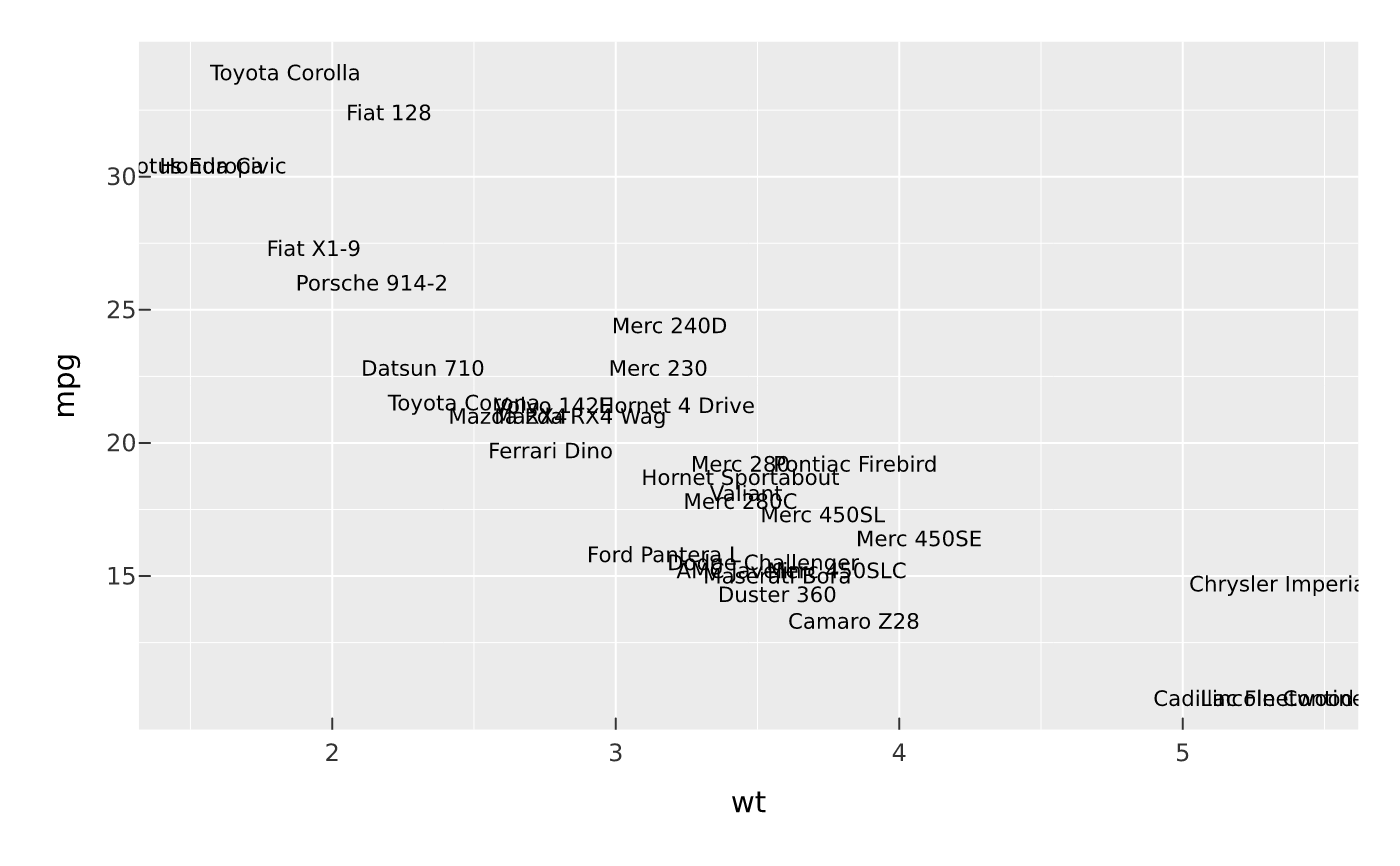
vplot(mtcars) |> mark_text(x = wt, y = mpg, label = rownames(mtcars))
 vplot(mtcars) |> mark_point(x = wt, y = mpg) |>
mark_text(x = wt, y = mpg, label = rownames(mtcars), nudge_y = 2)
vplot(mtcars) |> mark_point(x = wt, y = mpg) |>
mark_text(x = wt, y = mpg, label = rownames(mtcars), nudge_y = 2)