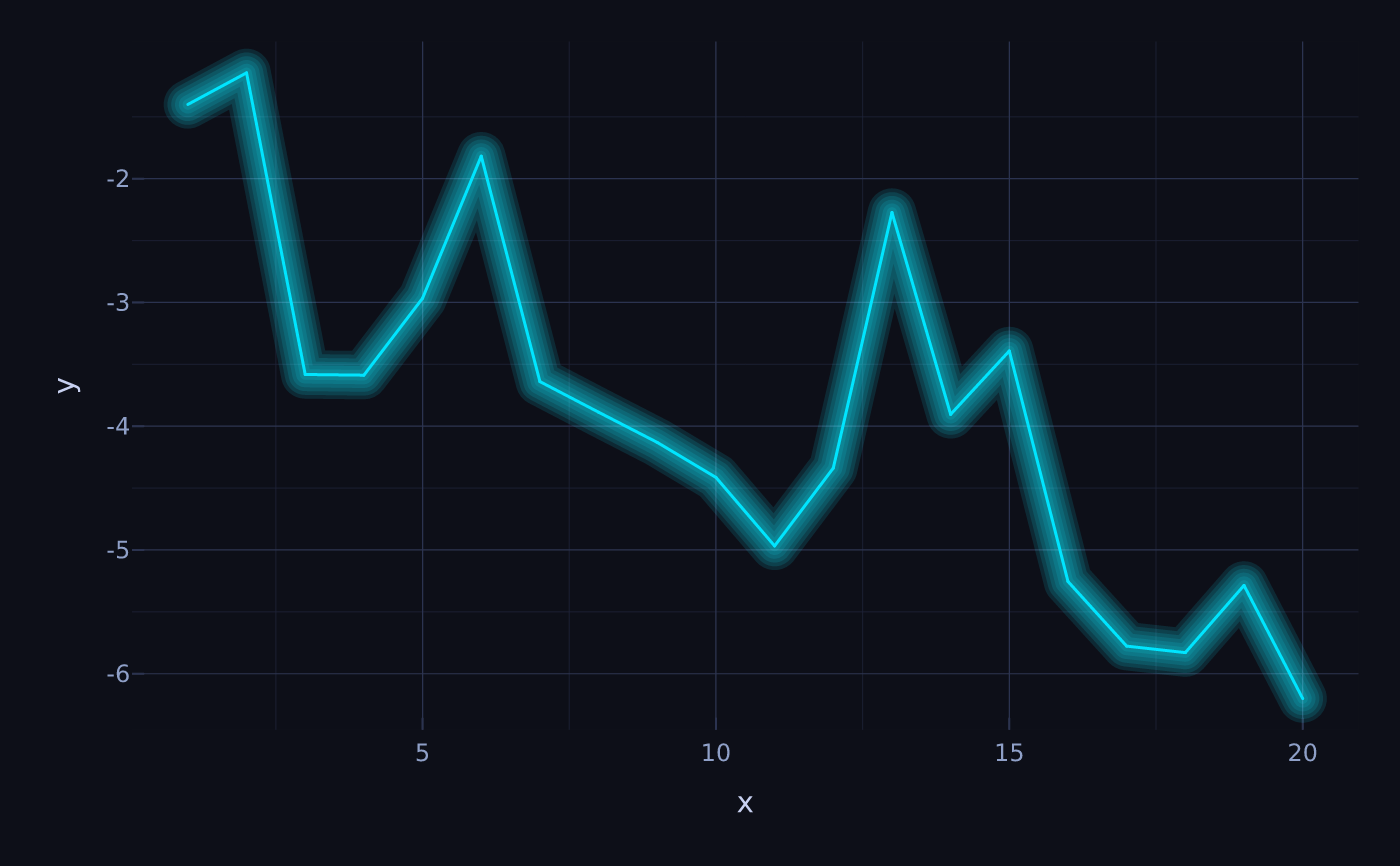
A render effect for stroked, point, and text marks, in the spirit of
mplcyberpunk: a widened copy of the
mark is drawn beneath the crisp original and softened with a real Gaussian
blur (vellum's vl_viewport(blur=)), composited additively (a "screen"
blend) into a soft neon halo. Pass it to a mark's effects argument, e.g.
mark_line(..., effects = list(glow())). Pairs naturally with
theme_cyberpunk().
Arguments
- size
Halo spread in millimetres: the blur radius (and, for stroked/point marks, how much the copy is widened before blurring).
- layers, blend
Retained for compatibility and the neon look:
layersscales the halo opacity (it no longer stacks copies – one blurred layer replaces them), andblend(typically"screen"/"lighten") composites the halo.- alpha
Base halo opacity (scaled by
layers).- color
Halo colour, or
NULL(default) to inherit the mark's own resolved colour — the usual neon look.
Details
The glow is applied per style group, so a colour-mapped multi-series line
glows each series in its own hue. It applies to mark_point(), mark_line(),
mark_step(), mark_rule(), mark_segment(), mark_edges(), mark_nodes(),
mark_edge_bundle(), mark_flow_map(), and text marks (mark_text() /
mark_label()); other marks reject it.
Examples
df <- data.frame(x = 1:20, y = cumsum(rnorm(20)))
vplot(df) |>
  mark_line(x = x, y = y, color = "#00e5ff", effects = list(glow())) |>
  theme_cyberpunk()