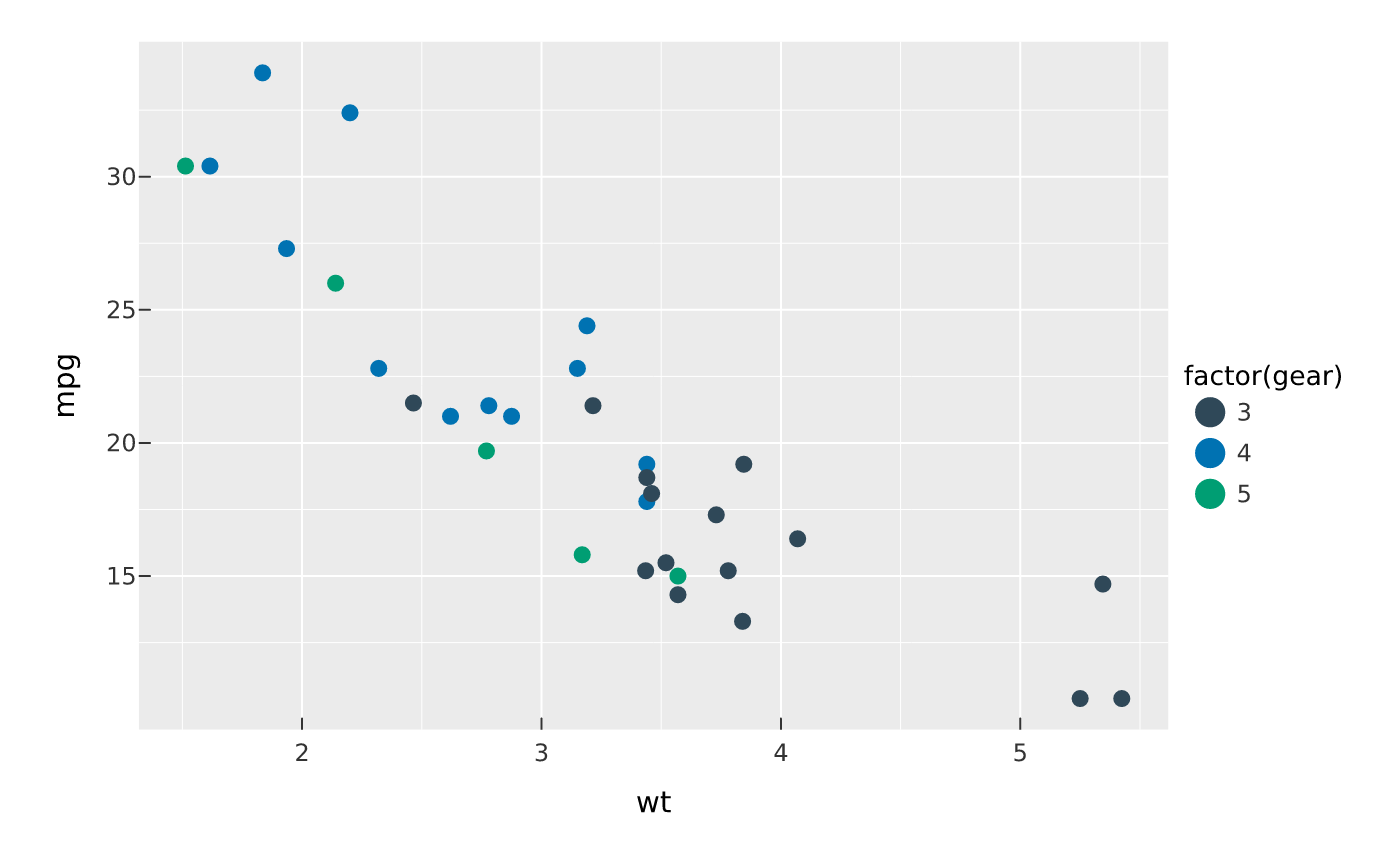
ease_aes() chooses the easing function that shapes how the interpolation
fraction moves through each transition — e.g. "cubic-in-out" starts and ends
gently. By default it applies to every interpolated aesthetic; the
position/color/size/alpha arguments override it for one class each, so
marks can glide into place on a cubic curve while their colour crossfades
evenly.
Usage
ease_aes(
  plot,
  ease = "linear",
  position = NULL,
  color = NULL,
  size = NULL,
  alpha = NULL,
  colour = NULL
)
Arguments
- plot
A PlotSpec carrying a
transition_states().- ease
An easing name:
"linear", or a family (quad/cubic/quart/quint/sine/expo/circ/back/elastic/bounce) with a direction suffix (-in,-out,-in-out), e.g."cubic-in-out". Used for any class not given its own easing below.- position, color, size, alpha
Optional per-class easings, named the same way as
ease.NULL(the default) means "useease". Each covers one class of drawn property:position— x and y, and every other coordinate-space quantity (bar widths, angles, path vertices, text rotation). It also decides when discrete attributes flip, since those snap at the halfway point.color—colorandfill, including per-element fills.size—size,linewidth, and radii.alpha— opacity, and the fade of marks entering or leaving a state.
positioncovers x and y together: the engine has a single positional curve, so the two axes cannot be eased apart.- colour
An alias for
color; supplying both is an error.
Value
The modified PlotSpec.
Examples
vplot(mtcars) |>
mark_point(x = wt, y = mpg) |>
transition_states(cyl) |>
ease_aes("cubic-in-out")
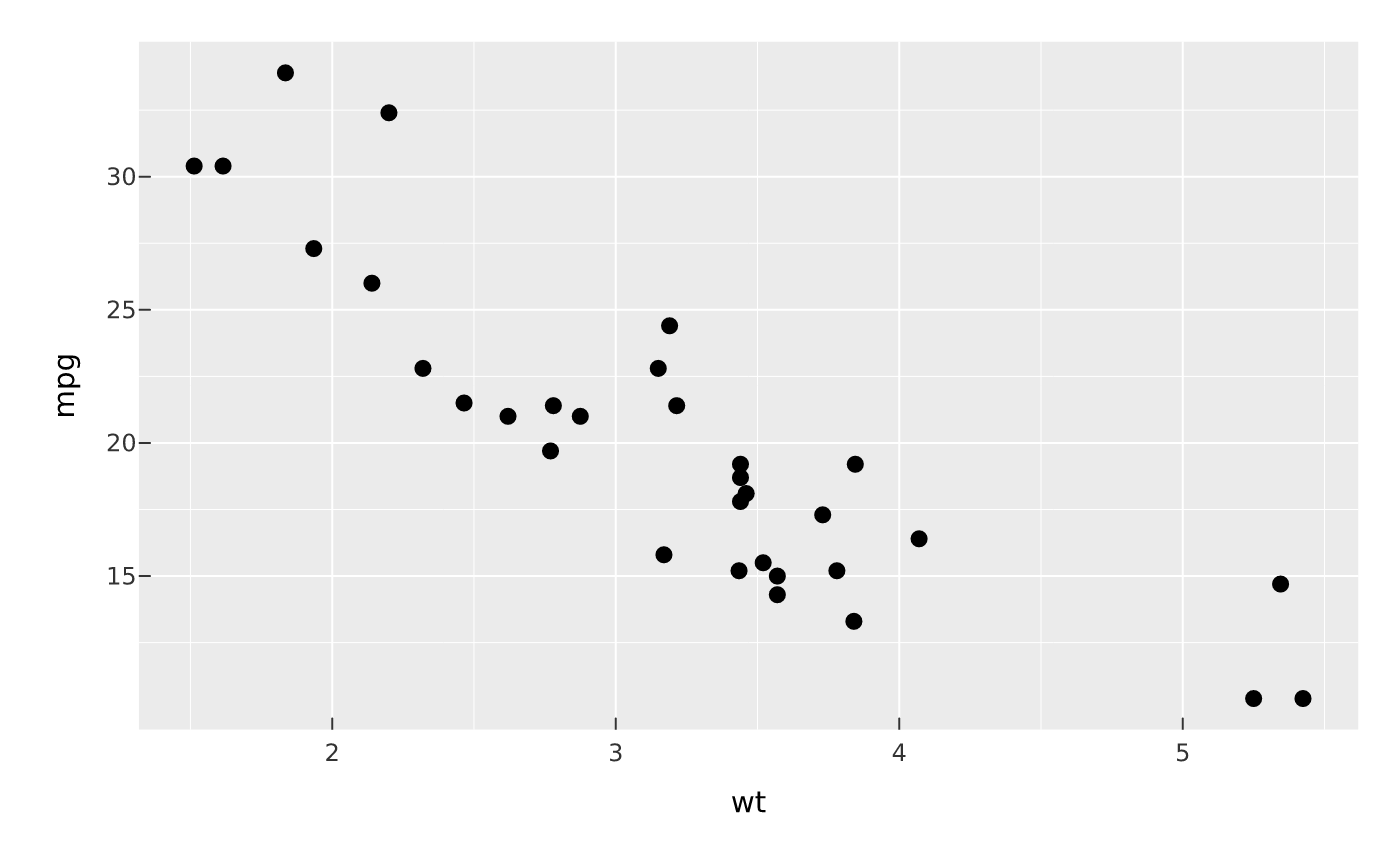 # Marks settle into place gently, but the colour crossfade stays even.
vplot(mtcars) |>
mark_point(x = wt, y = mpg, color = factor(gear)) |>
transition_states(cyl) |>
ease_aes("cubic-in-out", color = "linear")
# Marks settle into place gently, but the colour crossfade stays even.
vplot(mtcars) |>
mark_point(x = wt, y = mpg, color = factor(gear)) |>
transition_states(cyl) |>
ease_aes("cubic-in-out", color = "linear")