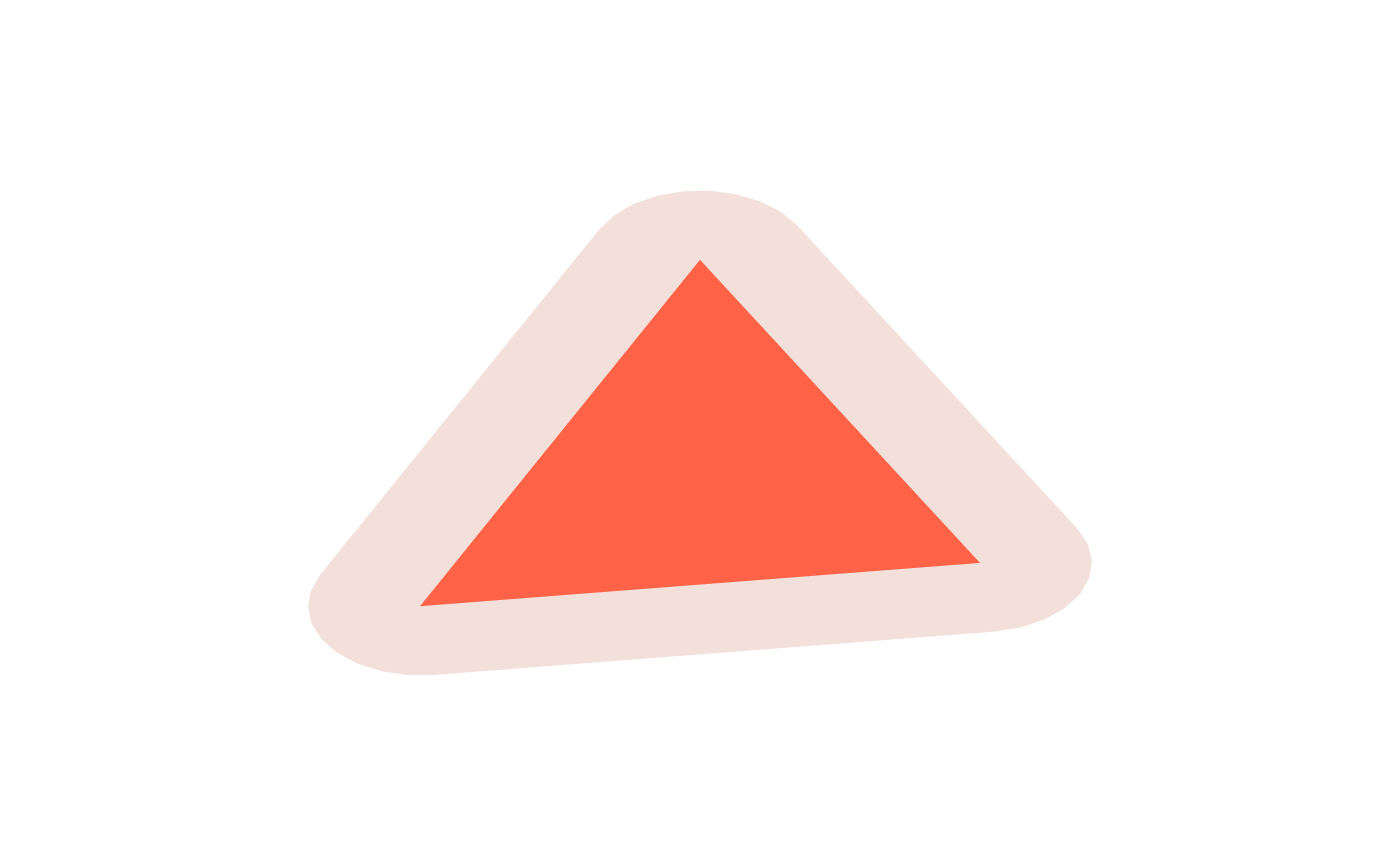
Grows a ring by width in every direction — the exclusion zone around a
region, the halo around a cluster outline, the standoff a leader line should
keep.
Details
Corners are rounded, which is what a standoff usually wants and what keeps the result well-defined at sharp angles (a mitred corner runs away to infinity as the angle closes).
On concave rings: the offset boundary of a concave polygon can cross
itself where the buffer is wider than a local feature. This function offsets
the ring and does not repair that, because repairing it is a boolean union —
a Phase 12 operation. Buffering a convex ring, or buffering by less than the
narrowest feature, is always well-behaved. Passing the result through
vl_hull() is a crude but effective fix when it is not.
Examples
tri <- data.frame(x = c(0.3, 0.7, 0.5), y = c(0.3, 0.35, 0.7))
buf <- vl_buffer(tri$x, tri$y, 0.08)
vl_scene(3, 3, dpi = 96, bg = "white") |>
  draw(polygon_grob(buf$x, buf$y, gp = vl_gpar(fill = "#F3E0DA", col = NA))) |>
  draw(polygon_grob(tri$x, tri$y, gp = vl_gpar(fill = "tomato", col = NA)))