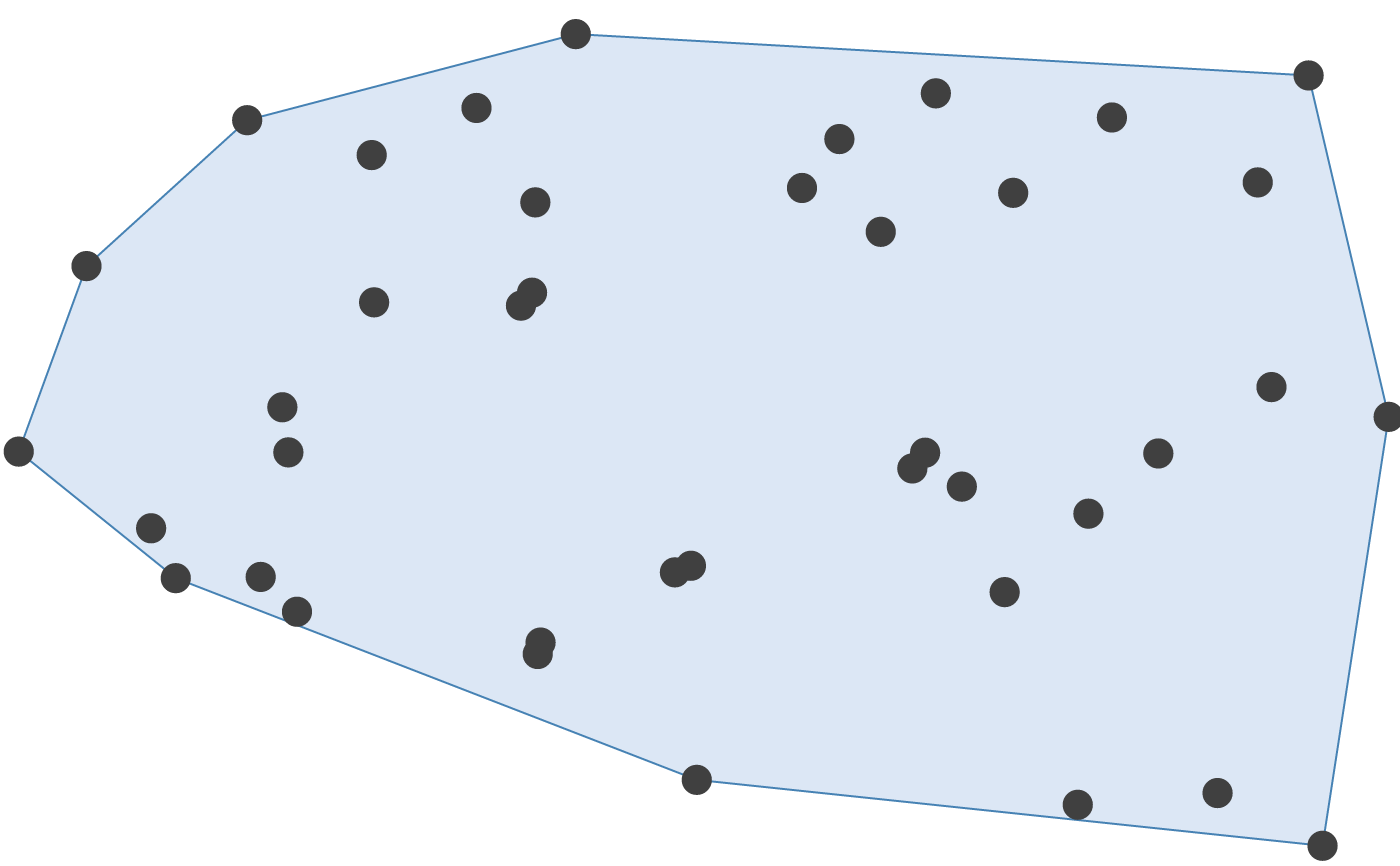
vl_hull() returns the convex hull, or a concave one that follows the point
set more closely — useful for outlining a cluster, or for building an
exclusion zone that annotations should avoid.
Value
A data frame of the hull ring's x/y, in order, ready for
polygon_grob(). The ring is not closed (the last point does not repeat
the first).
Details
The concave hull digs into the convex hull, replacing an edge with two edges
through the nearest unused point whenever the edge is long relative to the
detour. concavity is that threshold, and larger means more convex:
Inf(the default) is exactly the convex hull.8follows the points loosely.4is a good tight outline for a scattered cluster.Below about
3the boundary starts to self-intersect.
Self-intersection is inherent to the method, not a defect to be fixed here — a boundary that threads between interior points has to cross itself eventually. Inspect the result if you push it hard.
Examples
set.seed(1)
pts <- data.frame(x = runif(40), y = runif(40))
h <- vl_hull(pts$x, pts$y)
vl_scene(3, 3, dpi = 96, bg = "white") |>
  draw(polygon_grob(h$x, h$y, gp = vl_gpar(fill = "#DCE7F5", col = "steelblue"))) |>
  draw(points_grob(pts$x, pts$y, gp = vl_gpar(fill = "grey25", col = NA)))