vl_svg_path() parses the d attribute of an SVG <path> into rings;
svg_grob() wraps that up as a drawable path_grob().
Arguments
- d
A character string of SVG path data, or (for
svg_grob()) a whole<svg>element to read<path>geometry and theviewBoxfrom.- x, y
Centre of the drawn icon.
- size
Size of the reference box's longer side, as a
vl_unit()— the viewBox when one is given, otherwise the path's own bounding box.- flip_y
Flip the y axis to convert from SVG's convention. Leave
TRUEunless yourdis already in a y-up space.- viewbox
The icon's SVG
viewBoxasc(xmin, ymin, width, height)or the attribute string"xmin ymin width height", sosizescales the box rather than the glyph's ink.NULL(default) uses a whole-<svg>document's own viewBox if present, else the path's ink bounds.- gp, name, vp, id, role
Passed to the returned
path_grob().
Value
vl_svg_path(): a data frame of x, y, id, closed.
svg_grob(): a path_grob().
Details
This is what makes vector icons usable as marks. Icon sets — Font Awesome,
Bootstrap Icons, Lucide, Material — ship one <path d="..."> per glyph, so
d is the unit of exchange, and the result here is real geometry: crisp at
any size, fillable with a gradient, strokable, and exported as <path> data
rather than an embedded bitmap.
Coordinate system
SVG's y axis points down and vellum's points up, so svg_grob() flips it
by default (flip_y = TRUE) — otherwise every icon arrives upside-down. The
geometry is then scaled so the longer side of its reference box maps to
size, preserving aspect, and centred on x/y. vl_svg_path() returns the
raw parsed coordinates without any of that, for callers doing their own
placement.
Sizing across an icon set — the viewBox
Icon sets draw every glyph inside one shared viewBox (commonly
"0 0 24 24") and pad each glyph within it, so a glyph's own ink fills only
part of the box. Sizing to the ink would blow each glyph up to size
individually — a sparse glyph would render far larger than a dense one from
the same set, and a lone icon larger than its nominal box. Pass the set's
viewbox (the four numbers c(xmin, ymin, width, height), or the raw
attribute string "0 0 24 24") and size maps the box instead, so every
glyph keeps its intended relative and absolute size. If you hand svg_grob()
a whole <svg>…</svg> element (see below) its viewBox is used automatically.
With no viewBox at all, sizing falls back to the path's own ink bounds.
What is supported
The whole d grammar: M/L/H/V/C/S/Q/T/A/Z in absolute and
relative forms, implicit repeated commands, the smooth-curve reflection rules,
and elliptical arcs. Curves are flattened to polylines.
svg_grob() also accepts a whole <svg> element as d: it reads the
<path> geometry and the document viewBox (needs the xml2 package).
Only <path> elements are read — other drawable shapes (<circle>, <rect>,
<line>, …) are not path data and are reported with a warning, not silently
dropped. The rest of SVG is still out of scope: no stylesheets, gradients,
<use>, clip paths, or element transforms — this reads geometry, not
documents.
Malformed data yields whatever parsed before the problem rather than an error: a truncated icon is easier to diagnose than a stack trace.
Examples
# A five-pointed star, as an icon set would ship it.
star <- "M12 2 L15 9 L22 9.3 L16.5 13.8 L18.5 21 L12 17 L5.5 21 L7.5 13.8 L2 9.3 L9 9 Z"
vl_scene(3, 2, dpi = 96, bg = "white") |>
draw(svg_grob(star, x = 0.5, y = 0.5, size = vl_unit(15, "mm"),
gp = vl_gpar(fill = "#F1C40F", col = "grey30")))
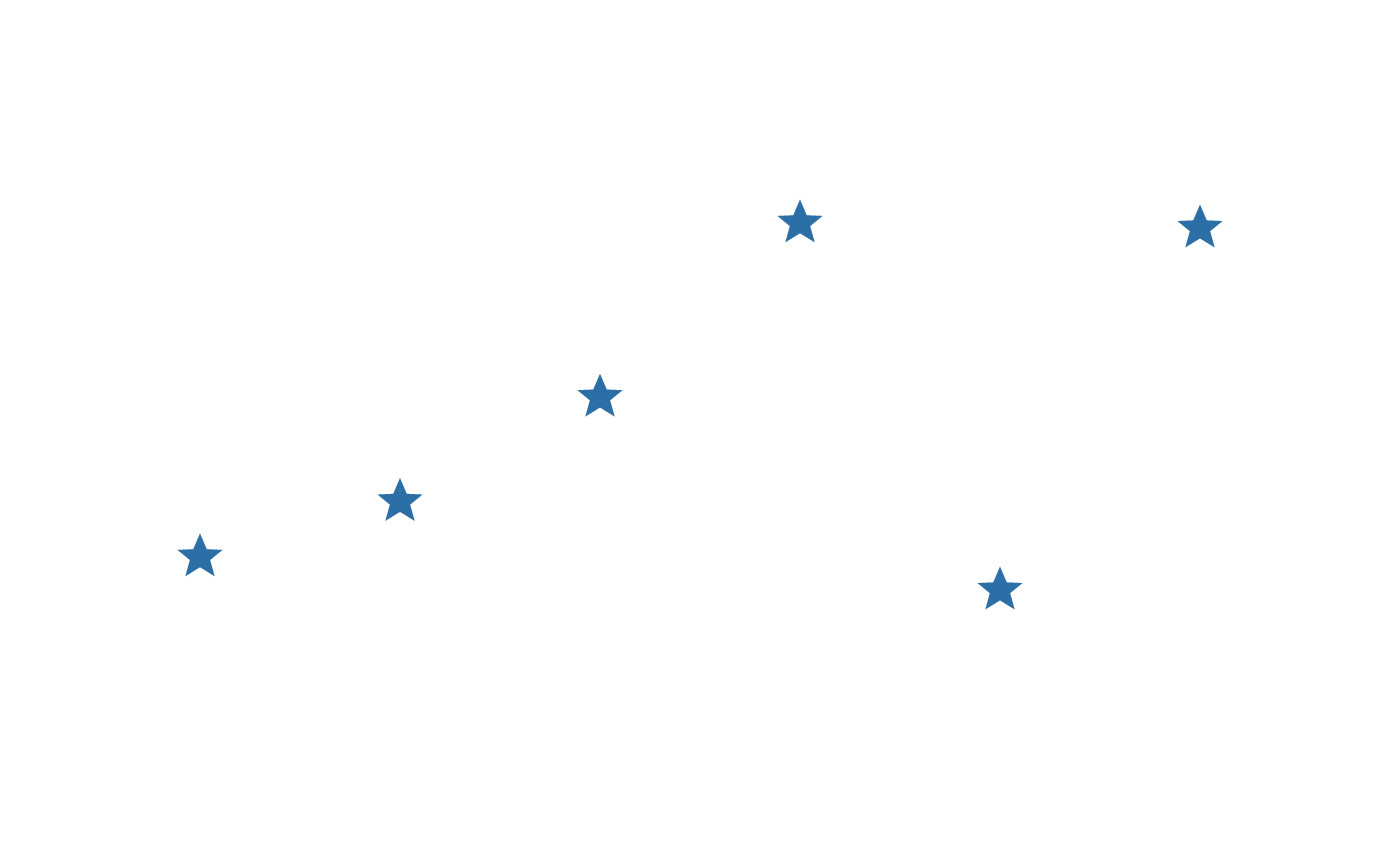
 # As per-point markers, which is what raster icons cannot do crisply.
set.seed(1)
s <- vl_scene(4, 2, dpi = 96, bg = "white")
for (i in 1:6) {
s <- draw(s, svg_grob(star, x = i / 7, y = runif(1) * 0.6 + 0.2,
size = vl_unit(6, "mm"),
gp = vl_gpar(fill = "#2C6FA6", col = NA)))
}
s
# As per-point markers, which is what raster icons cannot do crisply.
set.seed(1)
s <- vl_scene(4, 2, dpi = 96, bg = "white")
for (i in 1:6) {
s <- draw(s, svg_grob(star, x = i / 7, y = runif(1) * 0.6 + 0.2,
size = vl_unit(6, "mm"),
gp = vl_gpar(fill = "#2C6FA6", col = NA)))
}
s