ink <- "#3a2f1e"; paper <- "#faf5ea"; base <- "#c9a874"; hi <- "#c1121f"
vals <- c(3, 5, 2, 8, 6, 4, 7)
n <- length(vals)
y0 <- 0.18   # baseline

scene <- vl_scene(width = 7, height = 3.4, bg = paper)
for (i in seq_len(n)) {
  h <- 0.62 * vals[i] / max(vals)
  scene <- scene |>
    draw(rect_grob(
      x = (i - 0.5) / n, y = y0 + h / 2, width = 0.7 / n, height = h,
      name = paste0("bar", i),
      gp = vl_gpar(fill = base, col = NA)
    ))
}
scene <- scene |>
  draw(segments_grob(x0 = 0.02, y0 = y0, x1 = 0.98, y1 = y0,
gp = vl_gpar(col = ink, lwd = 1.5)))Retained-mode editing
Backend
A vellum scene is a retained graph of named nodes. Build it once, then get_node() and edit_node() to recolour a single element, without redrawing the rest.
A vellum scene is a retained graph: every grob and viewport stays addressable after you draw it. Give a node a name and you can find it again, read its properties, and rewrite them, leaving the rest of the scene untouched. grid can do this too, with grid.ls(), getGrob() and editGrob(); here the tree is a value rather than device state, and the same addressability is what hit_test() and scene_model() read geometry back through.
Here is a plain bar chart built from named rect_grobs. Each bar carries a name (bar1, bar2, …) alongside its geometry and fill.
Inspecting the graph
node_names() lists what is addressable, and get_node() hands back a single node so you can read its current state.
node_names(scene)
#> [1] "bar1" "bar2" "bar3" "bar4" "bar5" "bar6" "bar7"

get_node(scene, "bar4")@gp@fill
#> [1] "#c9a874"
Editing a node
edit_node() sets properties on the named node and returns a new scene; the original is left as it was (copy-on-modify). To highlight the tallest bar, find its name and rewrite only that node’s fill. No loop over the others, no rebuild.
top <- paste0("bar", which.max(vals))

highlighted <- edit_node(scene, top, gp = vl_gpar(fill = hi, col = NA))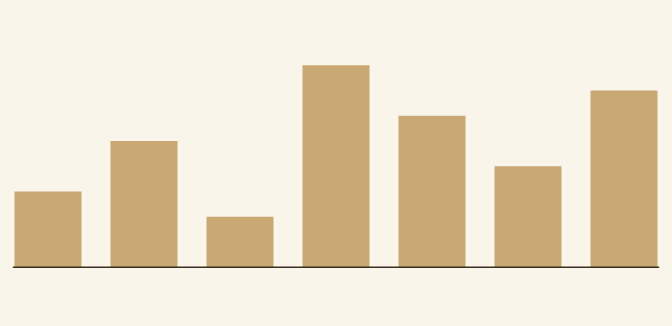
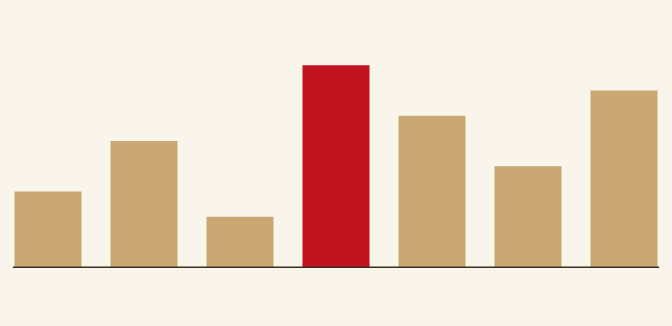
scene still shows every bar in the base colour, because edit_node() never mutated it. That copy-on-modify guarantee is what makes a scene safe to pass around: derive as many variants as you like from one base graph and none of them disturb the others.
The same retained graph is what vellumplot compiles a plot into, and what vellumwidget walks to attach per-element keys for interactivity. Naming a node is the seam between describing a scene and editing one after the fact.