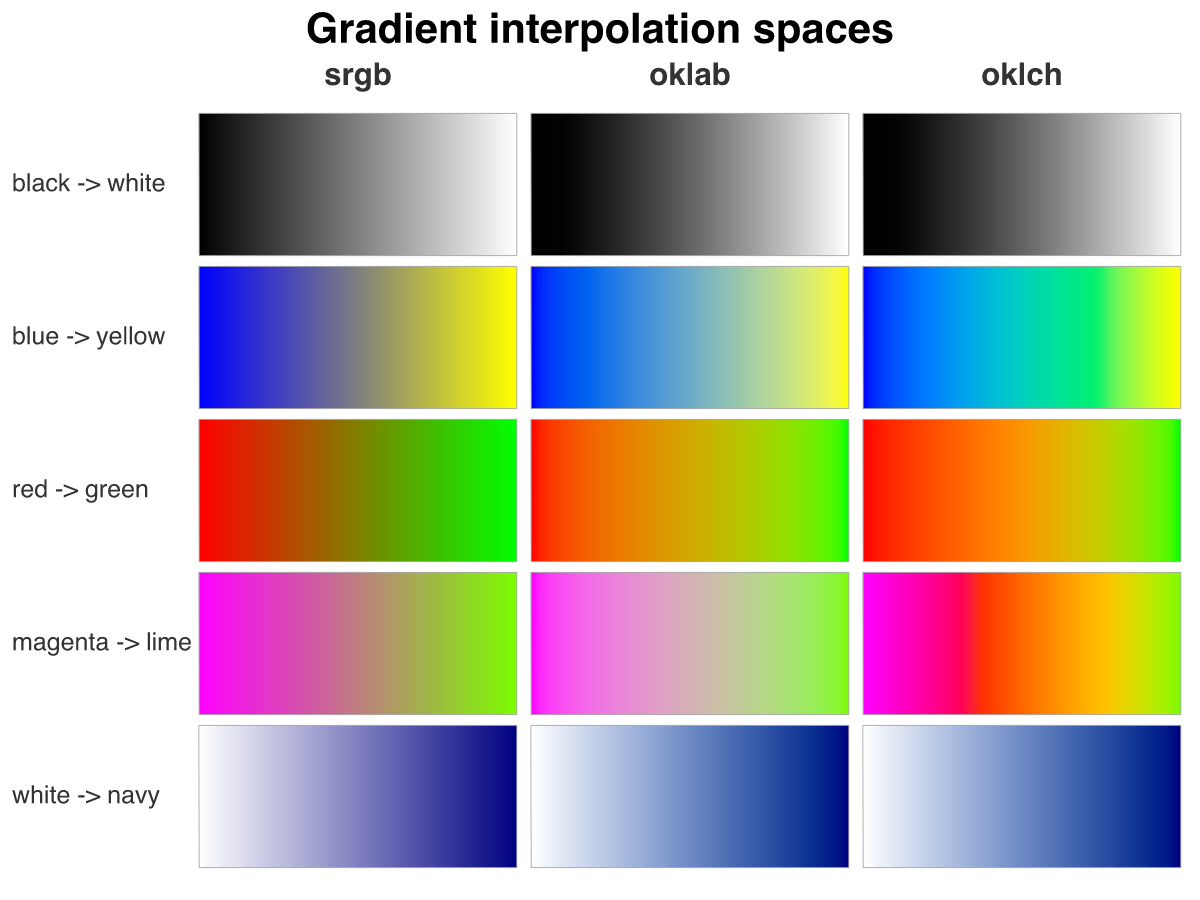
Blend the same gradient stops in sRGB, Oklab, or Oklch and watch what happens to the midtones.
A gradient between two colours has to decide what sits in the middle. vellum lets you pick the colour space where that blend happens, through the interpolation argument on linear_gradient() and radial_gradient().
"srgb" is the default and what most graphics backends do: a straight line in gamma-encoded sRGB. It is fast, but a ramp between two vivid colours dips through dark, muddy midtones. "oklab" walks a straight line through the perceptually uniform Oklab space, so lightness climbs evenly and the muddy dip disappears; near-complementary pairs still wash out toward grey in the centre, because the straight path passes close to the neutral axis. "oklch" moves through the polar form of the same space, letting hue and chroma travel on their own arcs, so the ramp stays saturated across the middle and sweeps through the intervening hues (blue to yellow goes by way of green).
The grid below runs five colour pairs through all three modes. The black-to-white row is a control: with no hue in play, only the lightness curve differs.
Show the scene code
modes <-c("srgb", "oklab", "oklch")pairs <-list(list(name ="black -> white", cols =c("black", "white")),list(name ="blue -> yellow", cols =c("blue", "yellow")),list(name ="red -> green", cols =c("red", "green")),list(name ="magenta -> lime", cols =c("magenta", "#7CFC00")),list(name ="white -> navy", cols =c("white", "navy")))nrow <-length(pairs)ncol <-length(modes)# Layout in scene npc: a label column, a title band, then a grid of swatches.label_w <-0.15x0 <- label_w +0.01x1 <-0.99top <-0.88bot <-0.03colw <- (x1 - x0) / ncolrowh <- (top - bot) / nrowpad <-0.006s <-vl_scene(width =8, height =6, dpi =150, bg ="white")s <-draw(s, text_grob("Gradient interpolation spaces", x =0.5, y =0.965,gp =vl_gpar(col ="black", fontface ="bold", fontsize =20)))for (j inseq_len(ncol)) { cx <- x0 + (j -0.5) * colw s <-draw(s, text_grob(modes[[j]], x = cx, y =0.915,gp =vl_gpar(col ="grey20", fontface ="bold", fontsize =15)))}# One swatch per (pair, mode): a rect filled with a left-to-right gradient# spanning the swatch's own viewport.for (i inseq_len(nrow)) { p <- pairs[[i]] yc <- top - (i -0.5) * rowh s <-draw(s, text_grob(p$name, x =0.01, y = yc, just =c("left", "centre"),gp =vl_gpar(col ="grey20", fontsize =12)))for (j inseq_len(ncol)) { cx <- x0 + (j -0.5) * colw vp <-vl_viewport(x = cx, y = yc, width = colw -2* pad, height = rowh -2* pad) grad <-linear_gradient(p$cols, x1 =0, y1 =0.5, x2 =1, y2 =0.5,interpolation = modes[[j]]) s <- s |>push(vp) |>draw(rect_grob(gp =vl_gpar(col ="grey60", lwd =0.5, fill = grad))) |>pop() }}
Read the vivid rows across and the trade-off is clear. sRGB darkens; Oklab keeps the lightness honest but drains colour from the centre; Oklch holds the chroma and pays for it by touring the hues in between. The perceptual modes are pre-sampled into dense sRGB stops inside the Rust core, so the raster, SVG, and PDF backends all produce the same ramp. This is the backend that vellumplot draws on for its fills and scales.